Processed Movement: The Cellular Crisis of the Sedentary Desk
Why a 10,000-step walk can’t fix an 8-hour sit—and the 2-minute “Micro-Exertion” for cellular longevity

The “Active Couch Potato”: The Comfort Trap
We live in a world engineered to remove friction. Escalators glide us up single flights of stairs, ergonomic chairs cradle our spines, and vehicles transport us across short blocks.
Modern convenience has systematically processed physical effort entirely out of our lives.
Many health-conscious individuals try to counteract this lifestyle by hitting the gym for 45 minutes or reaching a 10,000-step goal on their fitness trackers, trusting these bursts of activity will shield them from chronic illness.
However, science has recently uncovered a troubling phenomenon known as the “Active Couch Potato” (which I explored in a previous post). Specifically, if you exercise vigorously for under an hour but spend the remaining eight to ten hours sitting statically at a desk, your biology reacts almost identically to someone who doesn’t exercise at all.
You cannot out-exercise a sedentary lifestyle. Our evolutionary biology requires consistent, low-level physical feedback throughout the day to trigger vital cellular mechanisms. When that feedback is processed out, our cellular health begins to decline.
Most people equate physical movement strictly with formal exercise. But that is a profound oversimplification. In reality, modern systems engineered natural movement out of daily life, then invented “exercise” to fill the void. This explains why working out feels like such an uphill battle: it is no longer embedded in our day.
This realization is not an instruction; it is a recognition.
The modern world is extraordinarily efficient at reducing short-term discomfort while steadily driving up long-term chronic diseases. Perhaps our greatest health crisis is not merely ultra-processed foods, but an increasingly ultra-processed life or ultra-processed living.

The Environment: Systemic Patterns of Inactivity
Let’s face the facts. Modern environments default to physical stagnation:
Desks & Screens: Long work hours and screen time replace outdoor activity.
Delivery & Automation: On-demand delivery replaces walking; escalators replace stairs.
Why Movement Gets Crowded Out
The primary shift is environmental. Walkable neighborhoods, accessible sidewalks, bike paths, and mixed-use spaces are directly tied to higher rates of active transportation, like walking for errands or commuting. When these structural features are missing, we are forced to “manufacture” exercise on top of our daily lives instead of accumulating it naturally through routines.
Our professional and social structures reinforce this. Desk-bound jobs, streaming entertainment, and car-dependent commuting drastically slash the number of times our bodies are required to move. Evidence summarized by the American Heart Association (AHA) notes that even small, brief breaks from long sitting can improve cardiovascular and metabolic health.
The human body is a masterpiece of biomechanics, shaped by millions of years of survival. Every tissue from our feet to our brains was molded by the need to hunt, gather, and migrate across vast landscapes. For example, regular physical feedback triggers the release of proteins like BDNF (Brain-Derived Neurotrophic Factor), which promotes the growth and maintenance of brain cells while optimizing cerebral blood flow.1, 2
In short: we are biologically active creatures trapped in inactivity-permissive environments.
The Science: Cellular Stagnation and Mitochondrial Alteration
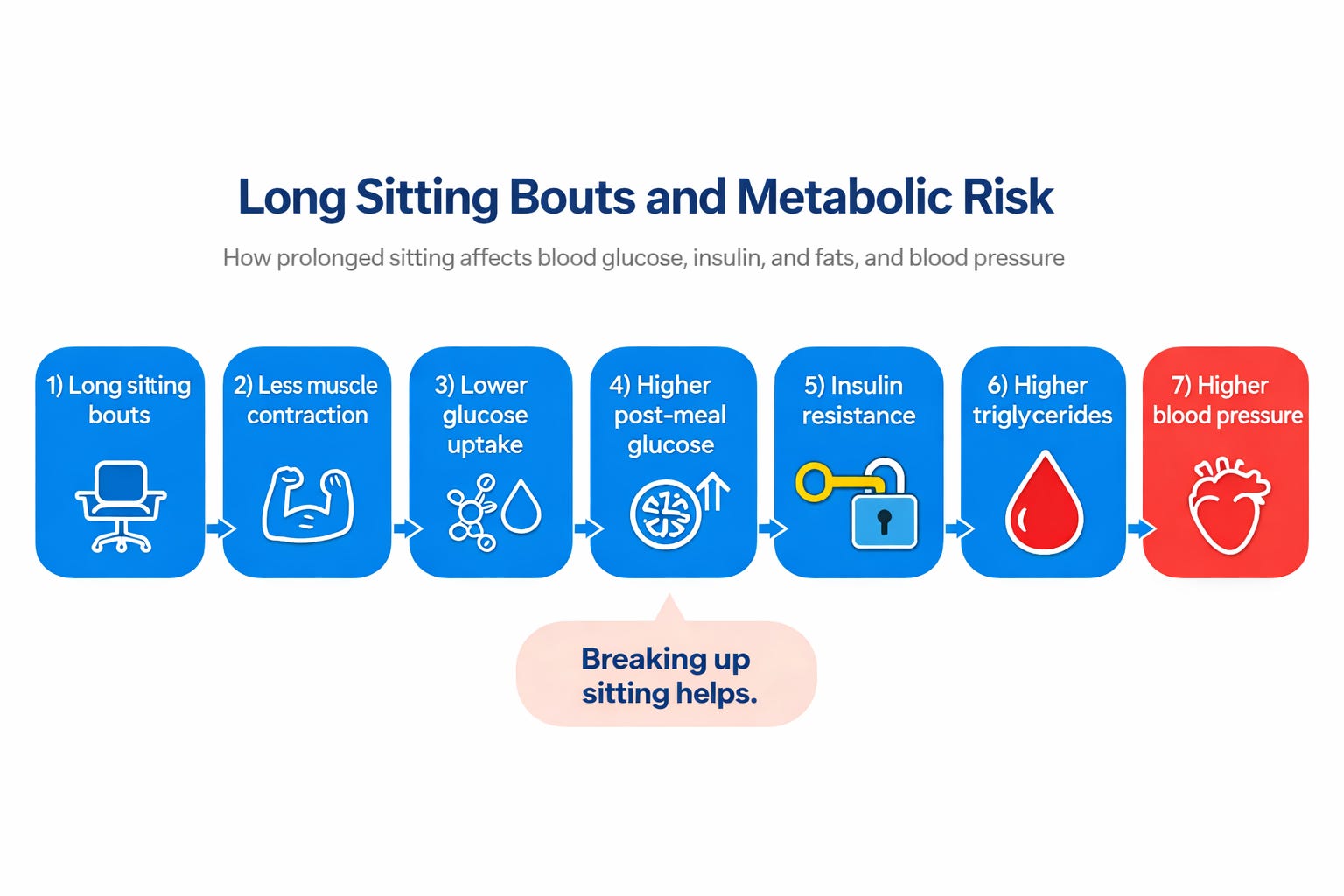
Because our genes still expect daily movement, prolonged sedentary behavior—defined as waking time spent sitting, reclining, or lying with minimal energy expenditure—causes our physiology to struggle, fueling modern chronic diseases. Figure 1 illustrates how these prolonged sitting bouts rapidly influence cardiovascular and metabolic parameters.
The Toll on Cellular Powerhouses
Physical stagnation disrupts the delicate balance of our mitochondria (the powerhouses of our cells). When muscles sit dormant for hours, the body’s natural cellular cleanup process stalls, and damaged mitochondria are not cleared out. Instead, they linger inside the cells, leaking highly destructive reactive oxygen species (ROS), which damages cellular DNA and creates a toxic microenvironment where cellular mutations, cancer, and metabolic diseases thrive.3,4
The stakes are remarkably high. The World Health Organization (WHO) identifies insufficient physical activity as a leading risk factor for cardiovascular disease, cancer, and diabetes. Similarly, the AHA links prolonged sitting to a significantly higher risk of heart attack, stroke, type 2 diabetes, and premature death.
The Power of the Dose-Response Relationship
Fortunately, modern insight reveals that the health benefits of movement follow a dose-response relationship, rather than an all-or-nothing rule.5 Small amounts of activity spread throughout the day yield massive dividends.
Recent physiological reviews show that breaking up sitting time with short, frequent interruptions produces meaningful improvements in glucose regulation, insulin sensitivity, blood pressure, and vascular function.6,7 Crucially, light-intensity walking stands out as a superior activity break.8
Sitting less is not just a health bonus; it is a fundamental biological necessity with measurable effects.
The Reality: Designing New Defaults
People often frame physical activity as a personal willpower issue, but our built environment strongly dictates what feels easy or normal. Research consistently associates walkable streets and close destinations with active travel. If a store is across a safe, neighborhood sidewalk, movement is baked into your day. If it is cut off by heavy traffic and sprawling infrastructure, movement becomes an optional chore.
Health is ultimately shaped by our defaults. To counter this with the best interventions, our personal and structural solutions must align:
Personally: We must embrace standing meetings, staircases, and active transport.
Structurally: Communities must expand sidewalks, trail networks, and bike infrastructure.
Our golden rule is simple: Reduce friction for bodily movement, and increase friction for prolonged sitting.
Your Practical Rx: The “Micro-Exertion” Exercise Snack
Perfection is impossible, and you don’t need to quit your office job. Instead, apply the 80/20 rule to your day. If you work a desk job or spend an hour or more watching a screen, introduce a 1-to-2-minute “exercise snack” every 60 minutes to disrupt cellular stagnation:
Stair Running: A quick burst up and down a flight of stairs.
Fast Pacing: Brisk walking or jogging, inside or outside.
Office Squats: Standing up from your chair, rising onto your tiptoes, and sitting back down. Repeat continuously.
Hydration Micro-Trips: Walking to get water frequently (which provides the dual benefits of movement and hydration).
Low-Impact Jacks: A knee-friendly alternative to jumping jacks—step one leg out to the side at a time while raising your arms, eliminating the impact.
Choose just one or two of these micro-exertions to start. They are all it takes to restart your cellular engines.
Closing —
A workable takeaway is to focus less on dramatic, sweeping behavior changes and more on shifting your daily “moving defaults.”
Make walking the default for short trips.
Make movement breaks the default for sitting-heavy days.
Use stairs, standing, and brief walks as routine anchors.
These mini-breaks from prolonged sitting open a new season of building cellular health, rather than just “getting fit.” They are the key to flourishing physically and refreshing mentally.
Image Credits: Created with Microsoft Copilot; Cooperated with CancerPreventionDaily
P.S. I share evidence-based daily practices to help you slash cancer risks and prevent chronic diseases so you can achieve lasting health. If my posts resonated with you, subscribe to receive Weekly FREE newsletter with practical health breakdowns directly in your inbox.
OR share with others who may benefit from the post. Sharing is caring.
Selected Key References (Selected from a long list of peer-reviewed papers)
1. Molska M, Mruczyk K, Cisek-Woźniak A, et al. The Influence of Intestinal Microbiota on BDNF Levels. Nutrients. 2024;16(17):2891.
2. Lee MC, Soya H. HIT Your Brain: Neuron and New Run. Adv Neurobiol. 2025;44:335-341.
3. Chauhan A, Vera J, Wolkenhauer O. The systems biology of mitochondrial fission and fusion and implications for disease and aging. Biogerontology. 2014;15(1):1-12.
4. Xu W, Xu X, Zhang Y, et al. Mitochondrial fission and fusion in inflammatory diseases: mechanisms and therapeutic implications. J Transl Med. 2025;24(1):127.
5. Duran AT, Friel CP, Serafini MA, et al. Breaking Up Prolonged Sitting to Improve Cardiometabolic Risk: Dose-Response Analysis of a Randomized Crossover Trial. Med Sci Sports Exerc. 2023;55(5):847-855.
6. Yin M, Xu K, Deng J, et al. Optimal Frequency of Interrupting Prolonged Sitting for Cardiometabolic Health: A Systematic Review and Meta-Analysis of Randomized Crossover Trials. Scand J Med Sci Sports. 2024;34(12):e14769.
7. Dong Y, Pan Y, Zhang X, et al. Impact of Prolonged Sitting Interruption on Blood Glucose, Insulin and Triacylglycerol in Adults: A Systematic Review and Meta-Analysis. Applied Sciences. 2024; 14(8):3201.
8. Buffey AJ, Herring MP, Langley CK, et al. The Acute Effects of Interrupting Prolonged Sitting Time in Adults with Standing and Light-Intensity Walking on Biomarkers of Cardiometabolic Health in Adults: A Systematic Review and Meta-analysis. Sports Med. 2022;52(8):1765-1787.
This is important information. Thank you Hui.
I take exercise/movement snacks to tend to my plants, fill my bottle of water or make a phone call while pacing back and forth or multitasking in the kitchen until the call is done.
Great article! Love the “micro-exertion” exercise snacks! The stair sprints are a great way to get short bursts of exercise. I try sprints or quickly walking skipping every other stair. I also do lunges in the hallways when they are empty. So many options to stay active. Thanks for sharing!!