Processed Rhythms: How Modern Life Throws the Body's Internal Clock Out of Sync
Modern life's relentless pace disrupts human circadian physiology—and how to restore it

Introduction
We live fast. We work faster. And our bodies keep score.
The heart beats harder. Stress hormones climb. Sleep grows shallow. Deadlines compress what used to be recovery time. But beneath all of this urgency, the body is not trying to go faster—it is trying to keep rhythm.
The rhythm of breath.
The rhythm of heartbeat.
The rhythm of the sleep-wake cycle (what scientists call the circadian rhythm).
The rhythm of work, and crucially, the rhythm of rest.
Consider the pancreas: it operates on its own internal clock, sensing food (sugar), producing insulin, and releasing it into the blood in precise, timed pulses. It is not built for randomness. Neither, as it turns out, is the rest of you.
Nature itself runs on cycles. Seasons slow. Darkness follows light. Recovery follows effort. Human health, at its foundation, depends on the same logic.
The question is: how do we keep our internal biological clocks synchronized with the world around us—when that world is increasingly designed to ignore them?
Processed Rhythms: What Modern Life Is Doing to Us
Modern life has introduced a new set of rhythms—artificial, relentless, and biologically foreign:
Artificial light that eliminates darkness
Chronic work pressure and “always-on” professional culture
Irregular, compressed, or late-shifted meal schedules
Constant digital stimulation and late-night screen exposure
Social jet lag—the gap between your body clock and your calendar
Each of these, alone, strains the body’s timing systems. Together, they create what we might call processed rhythms—environments engineered for productivity, convenience, and engagement, with no regard for biological recovery. The result is a population that is exhausted but under-rested, stimulated but cognitively depleted.
Artificial light at night (ALAN) has been specifically termed “light pollution”—a recognized environmental stressor with measurable health consequences.¹ But it is one thread in a larger pattern. The deeper problem is that modern environments are designed to be frictionless, stimulating, and immediately rewarding. The human body, however, evolved for something different: predictable cycles of effort and rest, light and dark, feeding and fasting.
Human physiology is organized by circadian rhythms that coordinate sleep, endocrine function, metabolism, immune signaling, and behavior across the 24-hour day. Under natural conditions, these rhythms are anchored by predictable light-dark cycles and regular patterns of feeding and fasting. Modern life has disrupted both—replacing sunlight and darkness with prolonged indoor illumination, and replacing structured meals with flexible, highly processed food intake at irregular hours.² Layered on top of this are psychological stressors that keep the nervous system in a sustained state of activation, blunting the hormonal signals the body relies on to shift from effort into recovery.
The quality of modern life has, without question, improved tremendously—productivity, safety, mobility, and convenience have all advanced. But those gains have come with a hidden biological cost: chronic internal desynchrony, wearing away quietly at the body’s most fundamental operating system.
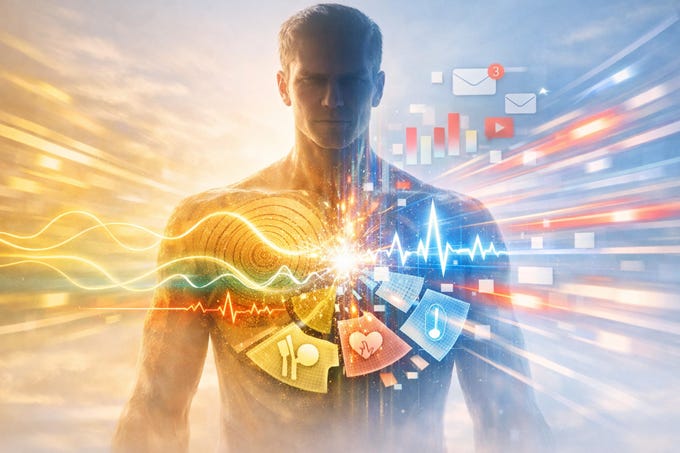
The Science of Circadian Rhythms: Your Body’s Internal Orchestra
Circadian rhythms do not simply regulate when you feel tired. They coordinate nearly every system in the body through a hierarchical network of biological clocks.
The master clock—the central conductor—sits in the hypothalamus. It does not tell each organ how to do its job; it tells each organ when. It translates light-dark cycles into rhythmic hormonal and neural signals, particularly through the release of melatonin (the darkness signal) and cortisol (the morning activation signal).³˒⁴
Peripheral clocks—local timekeepers or members embedded in the heart, lungs, gut, liver, pancreas, fat tissue, adrenal glands, and skeletal muscle—regulate organ-specific functions with remarkable independence. These clocks respond primarily to feeding and fasting cycles rather than light, making meal timing a powerful and often underappreciated regulator of biological rhythm.³
The downstream consequences are highly specific. The heart clock governs blood pressure, heart rate, and vascular responses, calibrating cardiovascular output to meet the physical demands of the day. The metabolic clocks of the gut, pancreas, and liver regulate insulin sensitivity, cholesterol synthesis, cellular repair or cleanup, and immune adaptation. Circadian biology is, at its core, precision scheduling—every function performed at its optimal window.
Circadian alignment is the harmonious synchronization between these internal clocks and external environmental cues. When that alignment breaks down, internal desynchronization follows, which can result from shift work, chronic overwork, late-night eating, or irregular sleep. The clocks fall out of phase with one another, and with the environment, significantly increasing risk for metabolic disorders, immune dysfunction, cardiovascular disease, and cancer.
The Hidden Risks: What Chronic Desynchrony Does to the Body and Brain
1. The rising burden of cardiometabolic disease and some cancers 1,5–7
Evidence increasingly points to timing mismatch as a driver of harm, not exposure duration alone. Chronic work stress, poor sleep, and late-night stimulation—whether from screens, foods, or psychological load—suppress melatonin, delay sleep onset, and keep the hypothalamic-pituitary-adrenal (HPA) axis in a state of low-grade activation. Over time, this translates into elevated cortisol patterns, insulin resistance, and systemic inflammation.
A complementary layer involves the gut microbiome. Feeding timing and dietary composition shape microbial rhythms, and microbial metabolites in turn influence circadian and metabolic regulation across the whole body. The gut microbiome functions as both a target and a mediator of circadian disruption, translating irregular feeding patterns into metabolic instability.⁶˒⁷ Processed foods and erratic meal timing alter microbiome composition, insulin sensitivity, and inflammatory responses in ways that compound the damage from light exposure and chronic stress.
Converging evidence suggests that these stressors—artificial light, digital overload, chronic work pressure, and irregular eating—disrupt circadian alignment at multiple levels simultaneously: the central clock, peripheral clocks, and downstream physiological processes. The result is increased risk for sleep disturbance, metabolic dysfunction, mood disorders, cardiovascular disease, and certain cancers.
2. Neurological consequences: the brain under chronic activation
Sustained exposure to the conditions of modern life—continuous stimulation, inadequate darkness, psychological pressure without recovery—has measurable neurological consequences. Even short-term continuous light exposure triggers neuroinflammation, impairs memory and cognitive performance, reduces neuroplasticity (the brain’s ability to rewire itself), and elevates cortisol, the very stress hormone that anchors the body’s internal clock.⁷ When the system that is supposed to regulate stress becomes chronically dysregulated by it, the feedback loop becomes self-reinforcing.
3. Sleep disturbance: the clearest signal of a system under strain
Sleep is where restoration happens — cellular repair, immune regulation, memory processing, and hormonal reset. It is not a passive state. It is active recovery, and it is the first casualty of processed rhythms.
A 2026 systematic review and meta-analysis of 15 epidemiological studies involving 765,838 participants found that individuals with higher exposure to artificial light at night had a 27% increased risk of sleep disturbance.⁸ People sleeping fewer than six hours per night face a 13% higher all-cause mortality risk.⁸
Chronic sleep disruption is associated with impaired cognition, weakened immunity, and elevated risk of obesity, diabetes, cardiovascular diseases, and neurodegenerative conditions including Alzheimer’s. It is also linked to depression, anxiety, and diminished quality of life—a compounding burden that touches every domain of health.
One important note: The causal evidence linking processed light specifically to these outcomes is not yet as definitive as the evidence for factors like obesity, smoking, or ultra-processed food. The associations are consistent and biologically plausible, but the science is still maturing. That context matters when interpreting risk.
Actionable Steps: Restoring Rhythm in a Rhythmless Environment
The goal is not to reject modern life. It is to protect your biological timing within it.
Begin by examining your current patterns: do you experience chronic fatigue, poor sleep, digestive irregularity, mood instability, or mental fog? These are often the first signals of desynchrony.
Practical strategies that work with your clocks rather than against them:
Protect your light environment. Limit bright light and screen exposure in the 1–2 hours before bed. Prioritize morning sunlight exposure to anchor your master clock early in the day.
Build recovery into your work rhythm. The always-on model is biologically unsustainable. Scheduled disengagement—from devices, from demands, and from stimulation—is not laziness; it is physiological necessity.
Time your meals with intention. Eat three regular meals and avoid large, late meals. The liver’s metabolic capacity is significantly reduced in the evening—eating late shifts metabolic load to a clock that is winding down.
Align your sleep schedule consistently. Irregular sleep timing creates social jet lag even without travel. A consistent sleep-wake cycle is one of the most powerful methods for circadian health.
Integrate cues, don’t isolate them. Light, food, movement, and sleep timing all speak to your clocks. Aligning all four, consistently, compounds the benefit.
Closing
Modern life did not set out to disrupt human biology. It optimized for speed, output, and convenience—and biology got left behind.
The result is a kind of chronic, invisible dysregulation: processed rhythms replacing natural ones, internal clocks running out of phase with the environment they evolved to track. This helps explain, at least in part, the rising burden of cardiometabolic disease, sleep disorders, cognitive decline, and mood disorders that characterize contemporary health.
The fix is not complicated, but it does require intention. Rhythm is not a luxury. It is the operating system beneath everything else your body does. Protect it, and a great deal else tends to follow.
Image credits: Created with Microsoft Copilot
P.S. I share evidence-based daily practices to help you slash cancer risks and prevent chronic diseases through upstream thinking for downstream health so you can enjoy lasting vitality.
If my posts resonate with you, subscribe to receive Weekly FREE newsletter with practical health breakdowns directly in your inbox.
Selected Key References (from a long list of peer-reviewed papers)
1. Wang T, Kaida N, Kaida K. Effects of outdoor artificial light at night on human health and behavior: A literature review. Environ Pollut. 2023;323:121321.
2. Fishbein AB, Knutson KL, Zee PC. Circadian disruption and human health. J Clin Invest. 2021;131(19):e148286.
3. Bautista J, Ojeda-Mosquera S, Ordóñez-Lozada D, et al. Peripheral clocks and systemic zeitgeber interactions: from molecular mechanisms to circadian precision medicine. Front Endocrinol (Lausanne). 2025;16:1606242.
4. Fagiani F, Di Marino D, Romagnoli A, et al. Molecular regulations of circadian rhythm and implications for physiology and diseases. Signal Transduct Target Ther. 2022;7(1):41.
5. Wojciechowska W, Hahad O, Daiber A, Rajzer M. Night light pollution and cardiovascular disease. Kardiol Pol. 2025;83(7-8):801-807.
6. Romanenko M, Bartsch M, Piven L, et al. Gut microbiota and circadian disruption in humans: Is there a rationale for metabolic disorders?. Chronobiol Int. 2025;42(9):1244-1264.
7. Korf HW, Bittner N, Caspers S, et al. Impact of artificial light at night and night shift work on brain functions and metabolism. Gen Comp Endocrinol. 2025;373:114822.
8. Kretzschmar J, Rath N, Starke KR, et al. The effect of exposure to artificial light at night (ALAN) on sleep disturbance: a systematic review and meta-analysis. Environ Res. 2026;292:123689.
This is excellent information well presented. Two sentences popped out at me: “Nature runs on cycles” and “The result is a population that is exhausted but under-rested, stimulated but cognitively depleted.” Humans are a product and a part of that same nature. To ignore that is to foster what’s described in the second sentence: burnout. Thank you for curating & posting, Hui.
I worked in commercial/industrial lighting for 30 years. LED changed lighting and started to address the circadian rhythm. Correlated color temperature and Kelvin temperature have a huge impact on people's behavior and, in health settings, healing. Check out the newest technology, called Human-centric lighting (HCL), a lighting design concept that mimics the natural daylight cycle to support human health, mood, and productivity, by automatically adjusting brightness and color temperature throughout the day, to help regulate the body’s circadian rhythm. People who work in settings with no natural light will be delighted!