Processed Connection: Wired but Disconnected as Social Isolation Sets in Modern Life
Balancing digital contact with human connection to protect your health

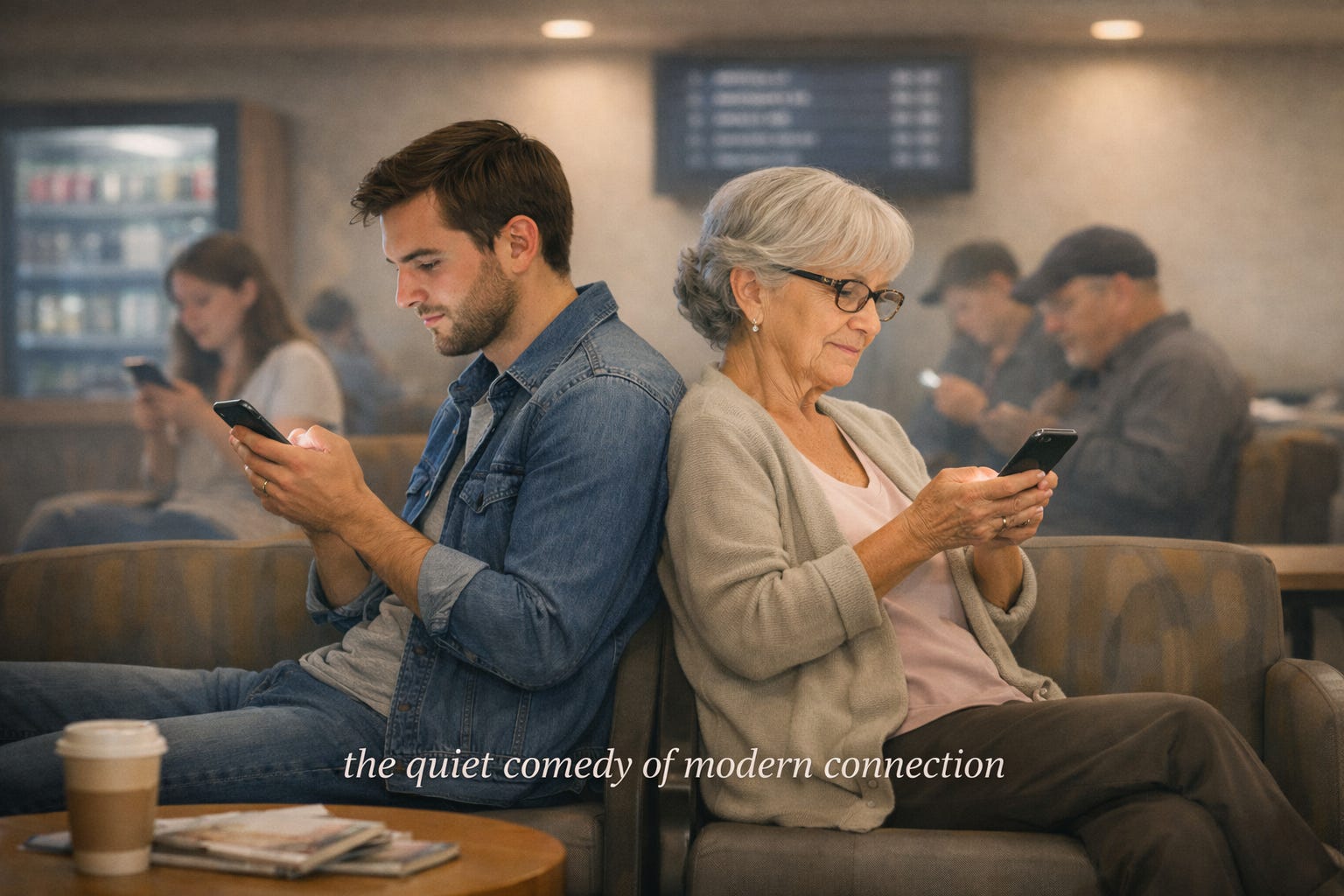
You can see it everywhere—grocery lines, hospital waiting rooms, even family gatherings. A quiet comedy plays out daily: we’re digitally crowded, yet emotionally isolated. We live in an age of miracle technology where someone can instantly video-call a friend across the globe, yet they might still hide behind the blinds to avoid making eye contact with a neighbor wheeling out the trash. As we head into a major holiday weekend, millions of people will experience the ultimate modern paradox: desperately wanting to celebrate with community, while simultaneously pretending to look at a phone to avoid awkward small talk at a July 4th barbecue.
We have more contact than at any point in human history, yet less actual connection. Messages arrive instantly and social feeds never sleep, making it easy to seem involved in one another’s lives without actually feeling close—or even known. This widening gap between digital echo chambers and true human connectedness isn’t just an awkward social dilemma; it is a critical public health crisis.
The Anatomy of Social Disconnection and Loneliness
To understand the crisis, we have to distinguish its terms. Social connection, social isolation, and loneliness are related but distinct. A person can live entirely alone and feel perfectly content, or sit in a crowded room and feel utterly unseen. Researchers separate these experiences because they register differently in the human body and affect health in different ways. The fundamental scientific question is not how many people we scroll past or pass in a hallway, but whether our relationships provide real support, meaning, and belonging.1,2
Maintaining that depth of belonging has become an uphill battle. Modern life demands frequent relocation, longer work hours, and a heavy reliance on digital communication. Technology itself is not the enemy; in many moments, it is a literal lifeline, keeping distant families staying in touch and allowing friends to check in across time zones.
The hazard arises when digital echoes become a permanent substitute for the slower, repeated, face-to-face encounters that build trust over time. A text can carry affection, and a video call can offer comfort, but neither can fully replace the ordinary, grounding ritual of being physically present with other people. When online interaction crowds out real-world life, the social fabric thins.
The loss of connection matters because the body does not treat this isolation as a trivial feeling. Over time, chronic disconnection alters our stress responses, compromises immune function, and shapes behaviors, eroding mental well-being.
The U.S. Surgeon General has flagged loneliness and isolation as a major public health hazard, emphasizing that relationships are not merely an emotional luxury. They are the literal environment in which our physical health either holds steady or breaks down.3
The Biological Toll: Heart, Metabolism, and Cellular Changes
Researchers have mapped three primary pathways through which social isolation damages the body.4–6
Behavioral: It triggers high-risk habits, such as physical inactivity, poor sleep, and smoking.
Psychological: It lowers self-esteem, limits active coping mechanisms, and dampens self-efficacy (our confidence in our own abilities).
Physiological: It directly impacts the body, driving up blood pressure and causing systemic inflammation and defective immune responses.
Consequence: Chronic Disease Risk
Cardiovascular Disease
The clearest data lies in cardiovascular health.5–7 A massive body of evidence links loneliness and social isolation to higher risks for heart disease, stroke, and premature mortality. This is a logical biological consequence. The cardiovascular system is highly sensitive to prolonged stress, and stress multiplies when people feel they are carrying it entirely alone. Supportive relationships act as a physiological buffer; isolation removes that buffer, leaving the body vulnerable to lack of recovery and a heavier wear-and-tear load over time.7
Diabetes
Diabetes management highlights the practical side of this pattern. Managing diabetes is a daily routine of food choices, blood monitoring, medication, and movement; not a one-time event. Social support functions as part of the infrastructure of this self-management. Friends, family, and community ties provide the encouragement, reminders, and accountability required to sustain individual health.8,9
Cancer
Cancer data offers a nuanced look at how isolation operates. New data tracking over 350,000 UK adults indicates that social isolation is a notable risk factor for developing cancer, showing distinct sex and organ-specific effects—particularly among women. Interestingly, the subjective feeling of loneliness did not show the same direct link to cancer risk as objective, physical isolation did.10
While the data on cancer remains complex, social ties heavily dictate cancer outcomes.11,12 Social connection is not a simple on-off switch for tumor growth, but it may influence the disease through stress, inflammation, treatment adherence, and the practical help, daily care required when a severe illness disrupts a person’s life.
The Bottom Line: Social isolation and loneliness are major risk factors for chronic diseases. Addressing them is a critical step for improving individual overall well-being and public health.
Shifting from Individual Blame to Collective Health
The overarching lesson is that loneliness is not a personal failure. It is a biological response to a fragmented social environment. If modern infrastructure—built on digital overload, long work hours, urban sprawl, and hyper-mobility—makes belonging harder to maintain, the remedy cannot rest solely on individual willpower.
Rebuilding social connection is health work, not sentimental work. Public health must look beyond treating disease after it appears, and begin designing settings where daily life happens and prevent isolation in the first place: workplaces that respect time, neighborhoods with shared spaces, and healthcare systems that treat social isolation as a vital sign.
The good news is that social infrastructure can be intentionally rebuilt and strengthened in collaborative ways. People can make room for repeated in-person contacts; not just digital check-ins. Clinicians can screen for social isolation just as they do for diet or sedentary lifestyles. Cities can invest in the places where relationships naturally grow—libraries, parks, volunteer networks, and civic organizations. Social connection is not merely a pleasant bonus of life; it is a protective shield.
Social connection is not merely a pleasant bonus of life; it is a protective shield.
Blueprints for Connection: July 4th Weekend and Beyond
Holiday weekends present a perfect, low-stakes friction point to interrupt the momentum of isolation and cultivate what sociologists call “social capital” (the shared values and networks that allow groups to effectively bond).
Immediate Actions for the Holiday Weekend
Initiate “Micro-Connections”: Reach out to two or three people who have drifted to the periphery of your life. Send a text, pick up the phone, or schedule a brief coffee.
Lean Into Local Rituals: Attend a town parade, neighborhood fireworks, or live outdoor music. Simply sharing a physical space with your immediate community lowers the psychological barrier of isolation.
Host or Invite with Intention: Organize or bring a friend to a simple backyard barbecue or park picnic. Focus less on hosting and more on creating an unhurried space for casual, extended conversation, maximizing the feelings of connectedness.
Sustainable Principles Beyond the Holidays
For Parents and Caregivers: Actively monitor the emotional tone of your children’s screen time. Discuss digital and social balance regularly, validating their struggles with online status and anxiety while intentionally creating family spaces to model deep listening.
For Individuals: Nurture relationships as an investment in your physical longevity. Consciously resist the gravitational pull of passive screen scrolling. Seek out opportunities to serve others; volunteering is one of the fastest ways to transform a stranger into a neighbor.
Happy July 4th, and here’s to deeper, healthier connections!
Image credits: Created with Microsoft Copilot
P.S. I share evidence-based daily practices to help you slash cancer risks and prevent chronic diseases through upstream thinking for downstream health so you can enjoy lasting vitality.
If my posts resonate with you, subscribe to receive Weekly FREE newsletter with practical health breakdowns directly in your inbox.
Selected Key References (from a long list of peer-reviewed papers)
1. Holt-Lunstad J. Social connection as a critical factor for mental and physical health: evidence, trends, challenges, and future implications. World Psychiatry. 2024;23(3):312-332.
2. Petersen B, Khalili-Mahani N, Murphy C, et al. The association between information and communication technologies, loneliness and social connectedness: A scoping review. Front Psychol. 2023;14:1063146.
3. Our Epidemic of Loneliness and Isolation: The U.S. Surgeon General’s Advisory on the Healing Effects of Social Connection and Community. 2023. https://www.hhs.gov/surgeongeneral/reports-and-publications/connection/index.html Accessed June 29, 2026
4. Hawkley LC, Cacioppo JT. Loneliness matters: a theoretical and empirical review of consequences and mechanisms. Ann Behav Med. 2010;40:218-27.
5. Hamer M, Steptoe A. Social isolation and stress-related cardiovascular, lipid, and cortisol responses. Ann Behav Med 2009;37:29-37.
6. Hawkley LC, Thisted RA, Masi CM, et al. Loneliness predicts increased blood pressure: 5-year cross-lagged analyses in middle-aged and older adults. Psychol Aging. 2010;25:132-41.
7. Valtorta NK, Kanaan M, Gilbody S, et al. Loneliness and social isolation as risk factors for coronary heart disease and stroke: systematic review and meta-analysis of longitudinal observational studies. Heart. 2016;102(13):1009-1016.
8. Shibayama T, Noguchi H, Takahashi H, et al. Relationship between social engagement and diabetes incidence in a middle-aged population: Results from a longitudinal nationwide survey in Japan. J Diabetes Investig. 2018;9(5):1060-1066.
9. Chen Y, Xue H, Ai S, et al. Trajectories of social isolation and loneliness and the risk of incident type 2 diabetes mellitus across genetic risk score. Diabetes Metab. 2024;50(3):101526.
10. Cheng J, Wang R, Feng Y, et al. A study of the associations between social isolation and loneliness with sex-specific cancer risk in the UK Biobank. Commun Med (Lond). 2026;6(1):200.
11. Social Isolation and Loneliness in Older Adults: Opportunities for the Health Care System. Washington (DC): National Academies Press (US); 2020 Feb 27. Chapter 3, Health Impacts of Social Isolation and Loneliness on Morbidity and Quality of Life. Available from: https://www.ncbi.nlm.nih.gov/books/NBK557983/
12. Boen CE, Barrow DA, Bensen JT, et al. Social Relationships, Inflammation, and Cancer Survival. Cancer Epidemiol Biomarkers Prev. 2018;27(5):541-549.
I think one thing that doesn't get addressed nearly enough in these discussions of the health benefits of social connections is the emotional regulation we provide each other. Humans regulate their emotional lives through contact with others (just watch a baby calm herself down when a caregiver picks her up and embraces her). Other people who are well regulated help you regulate, which means that your cortisol level stays within healthy limits and you feel more emotionally resilient and expansive. Conversely, too much alone time means heightened cortisol levels and more stress and anxiety.
This is a really great post. I reflected on this feeling today actually, especially as my family is not...familial. I think part of the difficulty is not just the space, but something you eluded to - the social consciousness about connection. I'm afraid of spending time with people who might just hurt me and leave again in the end.